Submissions[edit]
| Submission
|
Title
|
PDF
|
Authors
|
| DOSU
|
DOSU: DIFFICULTY-CONDITIONED ON-GRID SEQUENCE UNMASKING FOR OSU!TAIKO CHART GENERATION
|
PDF
|
Junyoung Koh, Hao-Wen Dong
|
| FumenLab
|
FUMENLAB: PLAN-CONDITIONED JOINT GENERATION AND REFINEMENT OF OSU!TAIKO CHARTS
|
PDF
|
Ryo Mitoma
|
| HiTaiko
|
HiTaiko: Hierarchical osu!Taiko Chart Generation via Metrical Candidate Selection
|
PDF / Poster
|
Sungjung Park
|
| MALer
|
RHYTHM GAME CHART GENERATION WITH PRE-TRAINED MUSIC TRANSCRIPTION MODEL
|
PDF
|
Sojeong An, Chris Donahue, Dasaem Jeong
|
Overall Results[edit]
Expert Evaluation Across Five Songs[edit]
Scores are averaged equally across the five evaluated songs (Silver Bullet, A fight in Tunisia, YUBIKIRI-GENMAN, Something Fun, and closer to you). Combined Quality includes Musical Representation, Creativity, and Gameplay; Human-Likeness is evaluated separately. Bold indicates the highest score in each subcolumn.
| Model
|
Musical Representation
|
Creativity
|
Gameplay
|
Combined Quality
|
Human-Likeness
|
| Within-song
|
Across-song
|
Within-song
|
Across-song
|
Within-song
|
Across-song
|
Within-song
|
Across-song
|
Within-song
|
Across-song
|
| DOSU
|
−1.8850 |
−1.8592
|
−1.5620 |
−1.3766
|
−0.4957 |
−0.6081
|
−1.9416 |
−1.4305
|
−1.6278 |
−1.5213
|
| FumenLab
|
1.4122 |
1.4946
|
1.4761 |
1.5760
|
0.6217 |
0.8282
|
1.2576 |
1.5429
|
0.8437 |
0.8177
|
| HiTaiko
|
1.0530 |
0.7580
|
−0.2570 |
−0.4161
|
1.1337 |
0.7907
|
1.1165 |
0.3365
|
2.4409 |
1.9699
|
| MALer
|
−0.5802 |
−0.3934
|
0.3429 |
0.2167
|
−1.2597 |
−1.0107
|
−0.4325 |
−0.4489
|
−1.6567 |
−1.2663
|
Qualitative Evaluation Across Five Songs[edit]
The following summarizes recurring observations in expert feedback based on Silver Bullet, A fight in Tunisia, YUBIKIRI-GENMAN, Something Fun, and closer to you.
| Model
|
Recurring strengths
|
Recurring limitations
|
Notable song and difficulty observations
|
| DOSU
|
Effective sound selection and comfortable patterns in some maps.
|
Uneven musical correspondence, inconsistent special-object use, and density that sometimes failed to follow musical intensity.
|
Oni and Muzukashii in Silver Bullet attracted praise, although assessments differed. Musical correspondence was criticized in A fight in Tunisia and Something Fun.
|
| FumenLab
|
Promising higher-difficulty patterning, rhythmic improvisation, and musical structure.
|
Sparse lower difficulties, awkward bursts, and technical defects that could undermine musical choices.
|
closer to you received consistent praise, particularly for Inner Oni. Near-overlapping notes compromised Oni and Inner Oni in Silver Bullet, while the complex Inner Oni climax in YUBIKIRI-GENMAN disrupted its gentle character.
|
| HiTaiko
|
Coherent musical organization, expressive color patterns, and comparatively consistent structure.
|
Conservative or repetitive mapping and insufficient differentiation between difficulties in some songs.
|
Oni in A fight in Tunisia and emotional progression in YUBIKIRI-GENMAN attracted praise. In closer to you, even Inner Oni remained sparse and similar to easier tiers.
|
| MALer
|
Adventurous rhythms and imaginative patterns that sometimes produced distinctive musical interpretations.
|
Unusual snapping, abrupt difficulty changes, and inconsistent musical fit.
|
Something Fun produced sharply divided assessments. YUBIKIRI-GENMAN and closer to you exposed difficulty-ordering problems and rhythms poorly suited to the musical material.
|
Player Evaluation on Himitsu feat. KAFU[edit]
Values are mean ratings across 11 participants. Bold indicates the highest mean among submissions, the human reference is shown with a shaded background.
| Mapper
|
Musical Representation
|
Creativity
|
Gameplay
|
Overall Quality Score
|
Human-Likeness
|
| DOSU
|
4.73
|
4.91
|
4.45
|
4.70
|
3.09
|
| FumenLab
|
5.91
|
4.55
|
5.18
|
5.21
|
5.27
|
| HiTaiko
|
4.55
|
3.82
|
4.00
|
4.12
|
3.27
|
| MALer
|
6.00
|
5.45
|
5.27
|
5.58
|
4.18
|
| Amasugi (human mapper)
|
8.36
|
7.36
|
8.64
|
8.12
|
8.82
|
Each participant contributes equally. Kantan, Futsuu, and Muzukashii received two responses each; Inner Oni received five; Oni received none. Overall Quality Score is the mean of Musical Representation, Creativity, and Gameplay; Human-Likeness is excluded.
Test Set[edit]
Song Selection[edit]
| Title
|
Artist
|
Genre
|
Language
|
Tags
|
BPM
|
| Silver Bullet
|
Ennnn
|
Electronic
|
Instrumental
|
breakcore, neurofunk, tech
|
89-379 (mostly 175)
|
| A fight in Tunisia
|
Sobrem & NIWASHI
|
Jazz
|
Instrumental
|
piano
|
148
|
| Something Fun
|
JOYLESS
|
Rock
|
English
|
male vocal
|
194
|
| closer to you (than ever before)
|
xiiiac13
|
Electronic
|
Instrumental
|
lo-fi
|
110
|
| YUBIKIRI-GENMAN
|
Mili
|
Pop
|
Japanese
|
j-pop, progressive, female vocal
|
59-146 (mostly 146)
|
| Himitsu feat. KAFU
|
MIMI
|
Pop
|
Japanese
|
j-pop, vocaloid
|
168
|
Default Settings[edit]
We followed the difficulty setting guidelines in osu!taiko ranking criteria to decide the default settings for each difficulty.
| Parameter
|
Kantan
|
Futsuu
|
Muzukashii
|
Oni
|
Inner Oni
|
| Overall Difficulty
|
3
|
4
|
5
|
5
|
6
|
| HP Drain Rate
|
8
|
7
|
6
|
5
|
5
|
Detailed Results[edit]
Algorithmic Evaluation Results[edit]
120 beatmaps were checked using AiMod across 4 models, 6 songs, and 5 difficulties. Star ratings were calculated using osu! star rating calculator.
Star ratings[edit]
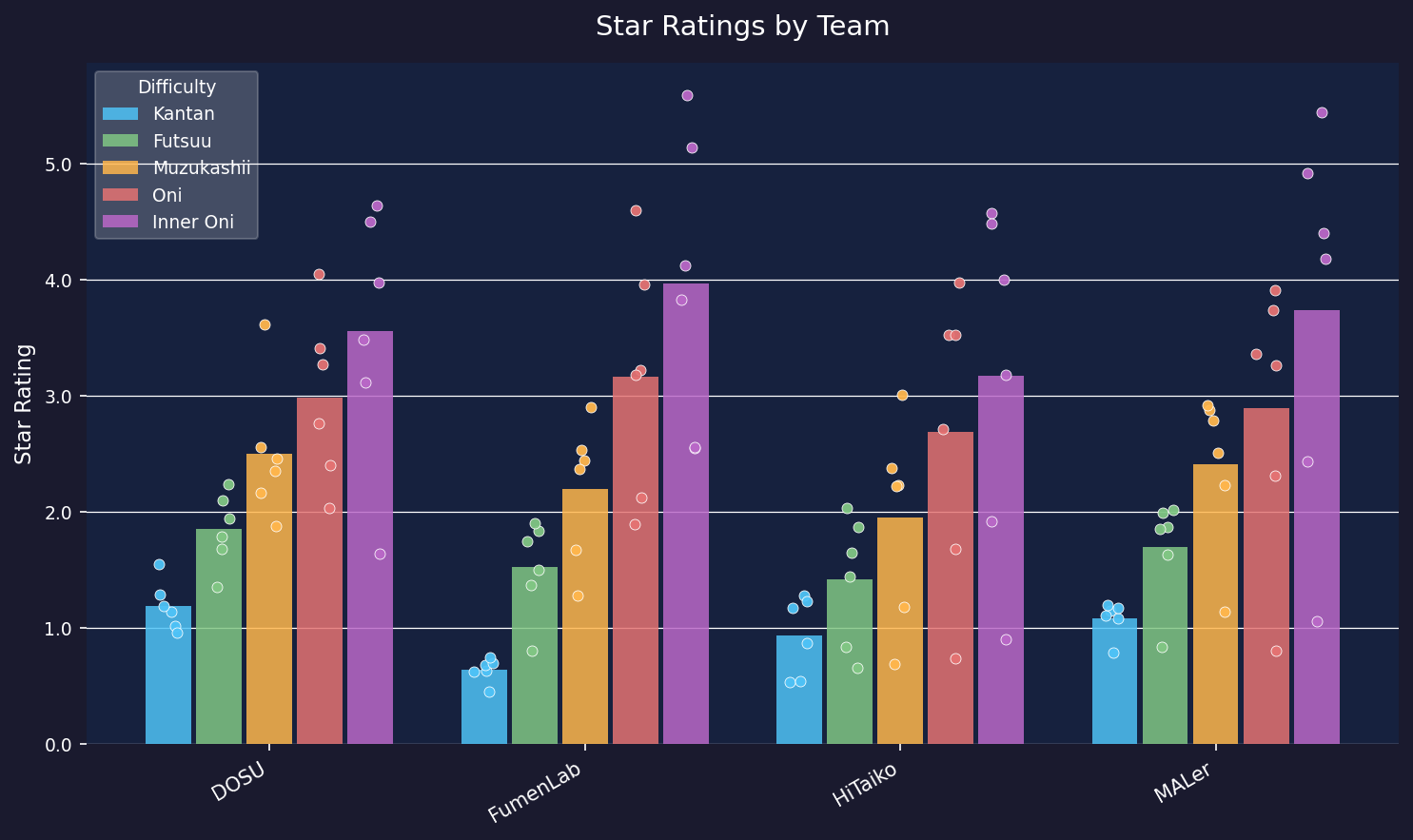
Star ratings by team. Bars show the mean across the 6 songs; dots show individual songs.
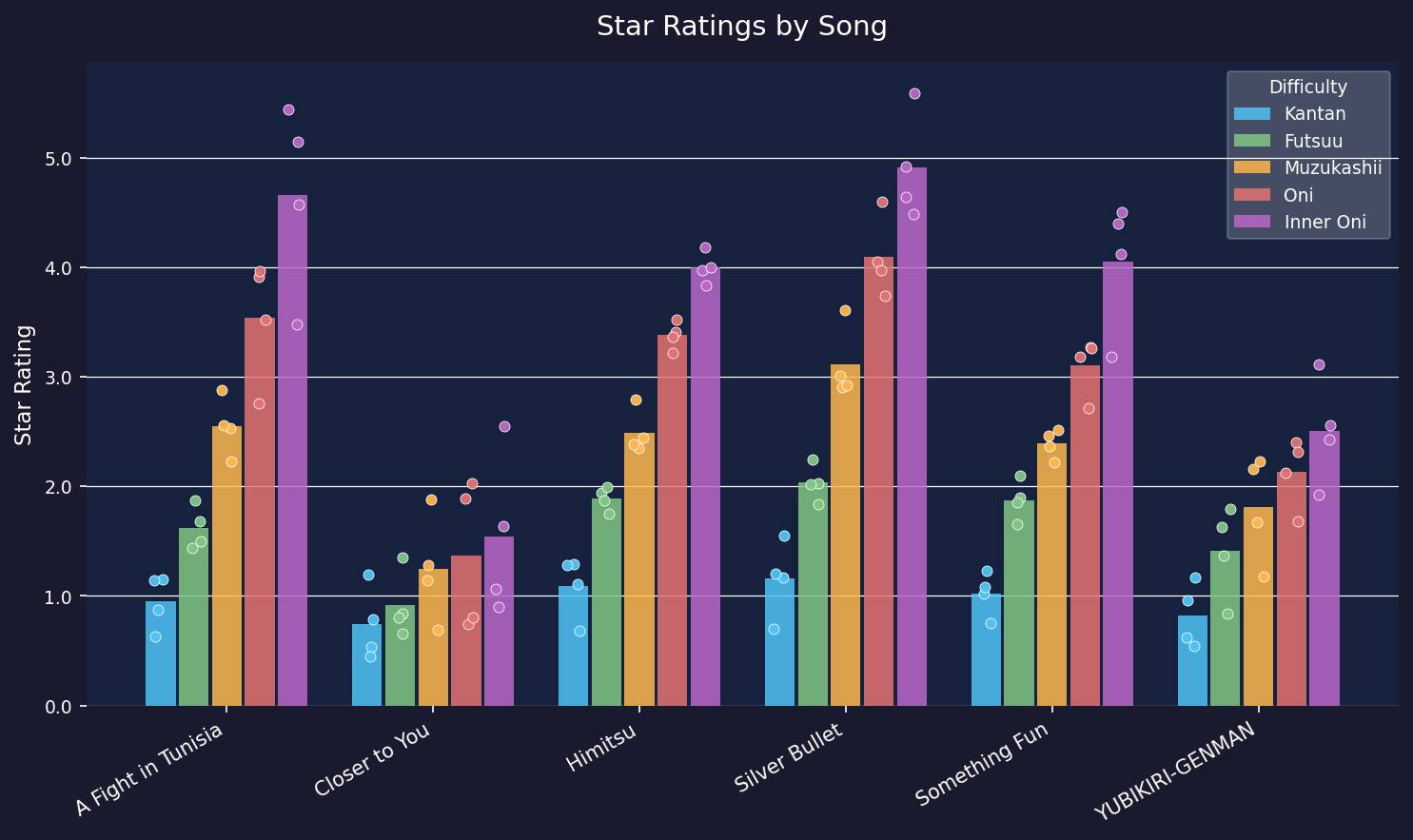
Star ratings by song. Bars show the mean across the 4 teams; dots show individual teams.
| Difficulty
|
Kantan
|
Futsuu
|
Muzukashii
|
Oni
|
Inner Oni
|
| Mean
|
0.96★
|
1.62★
|
2.27★
|
2.93★
|
3.61★
|
| Std. deviation
|
0.29
|
0.43
|
0.66
|
0.99
|
1.31
|
All four teams produce star ratings that increase with difficulty on average.
- FumenLab has the widest range, from 0.45★ to 5.59★.
- Consistent difficulty steps: mean star rating rises by about 0.65★ per difficulty, while the spread between maps of the same difficulty widens.
- Closer to You has the most compressed difficulties, with the HiTaiko set being near-flat (0.53★ Kantan to 0.90★ Inner Oni).
Difficulty ordering warnings:
- DOSU - closer to you - Inner Oni < Muzukashii < Oni
- MALer - closer to you - Kantan < Oni < Futsuu < Inner Oni < Muzukashii
NOTE: Calculating the star ratings in the latest osu!lazer version results in slightly different difficulty ordering warnings:
- DOSU - closer to you - Inner Oni < Oni
- MALer - closer to you - Kantan < Oni < Futsuu < Inner Oni < Muzukashii
- MALer - YUBIKIRI-GENMAN - Inner Oni < Oni
No difficulty ordering warnings are found in the latest osu!(stable) version.
| Song
|
Kantan
|
Futsuu
|
Muzukashii
|
Oni
|
Inner Oni
|
| Silver Bullet
|
1.55★
|
2.24★
|
3.61★
|
4.05★
|
4.64★
|
| A fight in Tunisia
|
1.14★
|
1.68★
|
2.56★
|
2.76★
|
3.48★
|
| Himitsu feat. KAFU
|
1.29★
|
1.94★
|
2.35★
|
3.41★
|
3.97★
|
| YUBIKIRI-GENMAN
|
0.96★
|
1.79★
|
2.16★
|
2.40★
|
3.11★
|
| Something Fun
|
1.02★
|
2.10★
|
2.46★
|
3.27★
|
4.50★
|
| closer to you
|
1.19★
|
1.35★
|
1.88★
|
2.03★
|
1.64★
|
FumenLab[edit]
| Song
|
Kantan
|
Futsuu
|
Muzukashii
|
Oni
|
Inner Oni
|
| Silver Bullet
|
0.70★
|
1.84★
|
2.90★
|
4.60★
|
5.59★
|
| A fight in Tunisia
|
0.63★
|
1.50★
|
2.53★
|
3.96★
|
5.14★
|
| Himitsu feat. KAFU
|
0.68★
|
1.75★
|
2.44★
|
3.22★
|
3.83★
|
| YUBIKIRI-GENMAN
|
0.62★
|
1.37★
|
1.67★
|
2.12★
|
2.56★
|
| Something Fun
|
0.75★
|
1.90★
|
2.37★
|
3.18★
|
4.12★
|
| closer to you
|
0.45★
|
0.80★
|
1.28★
|
1.89★
|
2.55★
|
HiTaiko[edit]
| Song
|
Kantan
|
Futsuu
|
Muzukashii
|
Oni
|
Inner Oni
|
| Silver Bullet
|
1.17★
|
2.03★
|
3.01★
|
3.97★
|
4.48★
|
| A fight in Tunisia
|
0.87★
|
1.44★
|
2.23★
|
3.52★
|
4.57★
|
| Himitsu feat. KAFU
|
1.28★
|
1.87★
|
2.38★
|
3.52★
|
4.00★
|
| YUBIKIRI-GENMAN
|
0.54★
|
0.84★
|
1.18★
|
1.68★
|
1.92★
|
| Something Fun
|
1.23★
|
1.65★
|
2.22★
|
2.71★
|
3.18★
|
| closer to you
|
0.53★
|
0.66★
|
0.69★
|
0.74★
|
0.90★
|
| Song
|
Kantan
|
Futsuu
|
Muzukashii
|
Oni
|
Inner Oni
|
| Silver Bullet
|
1.20★
|
2.02★
|
2.92★
|
3.74★
|
4.92★
|
| A fight in Tunisia
|
1.15★
|
1.87★
|
2.88★
|
3.91★
|
5.44★
|
| Himitsu feat. KAFU
|
1.11★
|
1.99★
|
2.79★
|
3.36★
|
4.18★
|
| YUBIKIRI-GENMAN
|
1.17★
|
1.63★
|
2.23★
|
2.31★
|
2.43★
|
| Something Fun
|
1.08★
|
1.85★
|
2.51★
|
3.26★
|
4.40★
|
| closer to you
|
0.79★
|
0.84★
|
1.14★
|
0.80★
|
1.06★
|
AiMod results[edit]
| Song
|
Kantan
|
Futsuu
|
Muzukashii
|
Oni
|
Inner Oni
|
| Silver Bullet
|
OK
|
OK
|
OK
|
OK
|
OK
|
| A fight in Tunisia
|
OK
|
OK
|
OK
|
OK
|
OK
|
| Himitsu feat. KAFU
|
OK
|
OK
|
OK
|
OK
|
OK
|
| YUBIKIRI-GENMAN
|
OK
|
OK
|
OK
|
OK
|
OK
|
| Something Fun
|
OK
|
OK
|
OK
|
OK
|
OK
|
| closer to you
|
OK
|
OK
|
OK
|
OK
|
OK
|
FumenLab[edit]
| Song
|
Kantan
|
Futsuu
|
Muzukashii
|
Oni
|
Inner Oni
|
| Silver Bullet
|
Minor snapping issue on drumrolls and swells
|
Minor snapping issue on drumrolls and swells
|
Minor snapping issue on drumrolls and swells
|
Objects <10ms apart and concurrent objects
|
Objects <10ms apart and concurrent objects
|
| A fight in Tunisia
|
Minor snapping issue on drumrolls and swells
|
Minor snapping issue on drumrolls and swells
|
OK
|
OK
|
OK
|
| Himitsu feat. KAFU
|
OK
|
OK
|
OK
|
OK
|
Minor snapping issue on drumrolls and swells
|
| YUBIKIRI-GENMAN
|
OK
|
Minor snapping issue on drumrolls and swells
|
Minor snapping issue on drumrolls and swells
|
OK
|
OK
|
| Something Fun
|
OK
|
OK
|
OK
|
OK
|
OK
|
| closer to you
|
OK
|
OK
|
OK
|
OK
|
OK
|
HiTaiko[edit]
| Song
|
Kantan
|
Futsuu
|
Muzukashii
|
Oni
|
Inner Oni
|
| Silver Bullet
|
Minor snapping issue on drumrolls and swells
|
Minor snapping issue on drumrolls and swells
|
Minor snapping issue on drumrolls and swells
|
Minor snapping issue on drumrolls and swells
|
OK
|
| A fight in Tunisia
|
OK
|
OK
|
OK
|
OK
|
OK
|
| Himitsu feat. KAFU
|
OK
|
OK
|
OK
|
OK
|
OK
|
| YUBIKIRI-GENMAN
|
OK
|
OK
|
OK
|
Minor snapping issue on drumrolls and swells
|
Minor snapping issue on drumrolls and swells
|
| Something Fun
|
OK
|
OK
|
OK
|
OK
|
OK
|
| closer to you
|
Unused audio at the end
|
Unused audio at the end
|
Unused audio at the end
|
Unused audio at the end
|
OK
|
| Song
|
Kantan
|
Futsuu
|
Muzukashii
|
Oni
|
Inner Oni
|
| Silver Bullet
|
OK
|
OK
|
OK
|
OK
|
OK
|
| A fight in Tunisia
|
OK
|
OK
|
OK
|
OK
|
OK
|
| Himitsu feat. KAFU
|
OK
|
OK
|
OK
|
OK
|
OK
|
| YUBIKIRI-GENMAN
|
OK
|
OK
|
OK
|
OK
|
OK
|
| Something Fun
|
OK
|
OK
|
OK
|
OK
|
OK
|
| closer to you
|
Unused audio at the end
|
Unused audio at the end
|
Unused audio at the end
|
Unused audio at the end
|
Unused audio at the end
|
Expert Evaluation Results[edit]
5 osu!taiko mappers evaluated submissions across 5 songs: Silver Bullet, A fight in Tunisia, YUBIKIRI-GENMAN, Something Fun, and closer to you. Each judge was assigned 3 songs based on their familiarity and interest of the songs, and each song was evaluated by 3 judges. For every assigned song, judges assessed submissions from all 4 models on 4 categories (Musical Representation, Creativity, Gameplay, and Human-Likeness) using an integer scale from 1 to 10. All beatmaps were anonymized as A, B, C, D. The letters were randomly shuffled per song, i.e. Mapset A in a song may not correspond to the same team as Mapset A in another song.
We adopt the judge-score normalization approach used by the Monthly Beatmapping Contest and report both within-song normalization and across-song normalization scores. For each category, a judge’s normalized score is calculated as (raw rating − judge’s mean rating) / judge’s population standard deviation. Within-song normalization uses the four submissions evaluated by that judge for the same song; across-song normalization uses all 12 submissions assigned to that judge across three songs. A submission’s category score is the sum of its three judges’ normalized scores. Combined Quality is calculated by first summing each judge’s raw ratings for Musical Representation, Creativity, and Gameplay, then normalizing these totals using the same procedure and summing the three judges’ normalized scores. Human-Likeness is evaluated separately and excluded from Combined Quality.
Silver Bullet[edit]
| Model
|
Musical Representation
|
Creativity
|
Gameplay
|
Combined Quality
|
Human-Likeness
|
| Within-song
|
Across-song
|
Within-song
|
Across-song
|
Within-song
|
Across-song
|
Within-song
|
Across-song
|
Within-song
|
Across-song
|
| DOSU
|
1.5872 |
1.9303
|
−2.6304 |
−0.6119
|
2.0099 |
1.2101
|
−0.9236 |
0.8593
|
−0.4552 |
−0.4745
|
| FumenLab
|
0.3005 |
1.8878
|
0.9401 |
1.1426
|
−3.5863 |
−2.9908
|
−1.5011 |
−0.0563
|
−1.9478 |
−1.6081
|
| HiTaiko
|
1.2778 |
2.6483
|
1.8629 |
2.8452
|
2.0099 |
1.2101
|
3.6945 |
2.5621
|
4.1634 |
3.0147
|
| MALer
|
−3.1656 |
−0.6386
|
−0.1726 |
0.6706
|
−0.4335 |
−1.0840
|
−1.2698 |
−0.3204
|
−1.7604 |
−1.4425
|
| Model
|
Qualitative Feedback
|
| DOSU
|
Musical representation drew mixed assessments. Oni and Muzukashii showed effective sound selection, but Inner Oni was conservative early and uneven near the ending. Inconsistent special-object use and variable-BPM handling weakened coherence across difficulties.
|
| FumenLab
|
Oni and Inner Oni showed promising sound selection, but awkward bursts and near-overlapping notes compromised gameplay near the ending. Kantan was excessively sparse, while intermediate difficulties were comparatively plain. Repeated musical phrases received inconsistent treatment.
|
| HiTaiko
|
Coherent musical representation and expressive color patterns were recurring strengths. Inner Oni made quieter passages disproportionately dense, while Oni was comparatively restrained. Futsuu and Muzukashii showed promising structure, although assessments of the lower-tier ending differed. Finisher placement remained inconsistent.
|
| MALer
|
Imaginative Oni patterns and distinctive sectioning were offset by rhythms that often felt disconnected from the music. Inner Oni contained timing and overlap problems; unusual subdivisions in Muzukashii and questionable sound selection in Futsuu weakened the difficulty spread.
|
A fight in Tunisia[edit]
| Model
|
Musical Representation
|
Creativity
|
Gameplay
|
Combined Quality
|
Human-Likeness
|
| Within-song
|
Across-song
|
Within-song
|
Across-song
|
Within-song
|
Across-song
|
Within-song
|
Across-song
|
Within-song
|
Across-song
|
| DOSU
|
−4.7037 |
−5.3766
|
−3.6090 |
−4.6191
|
0.4677 |
−0.1418
|
−4.0148 |
−4.1326
|
−1.5881 |
−2.3767
|
| FumenLab
|
0.2720 |
−1.1810
|
−0.2284 |
−1.7695
|
−2.4438 |
−2.4506
|
−0.7583 |
−2.0492
|
−0.1690 |
−0.8568
|
| HiTaiko
|
2.0747 |
0.3217
|
0.9776 |
−0.6639
|
2.2563 |
1.3928
|
2.0694 |
0.1551
|
2.3546 |
1.7015
|
| MALer
|
2.3570 |
0.9179
|
2.8598 |
1.3301
|
−0.2803 |
−0.2017
|
2.7037 |
0.7954
|
−0.5975 |
−1.2836
|
| Model
|
Qualitative Feedback
|
| DOSU
|
The mapping frequently missed prominent musical events across all difficulties. Conservative patterns supported playability, but omitted piano passages and notes in musically empty sections weakened representation. Isolated Inner Oni patterns showed potential without fitting the song.
|
| FumenLab
|
Awkward bursts, excessive local density and neglected piano passages weakened musical clarity. Kantan–Muzukashii lacked coherent sound selection; Oni was sometimes too demanding for its tier. Inner Oni was relatively stronger but remained rhythmically awkward.
|
| HiTaiko
|
Oni stood out for coherent sound selection and structure. Inner Oni was more conservative and relied on abrupt doublets, while Kantan–Muzukashii often omitted material or mixed musical layers inconsistently. Piano representation and repeated special-object placement remained weaknesses.
|
| MALer
|
Expressive color patterns attracted praise, but overall assessments differed. Complex snapping and inconsistent musical-layer selection reduced readability, particularly in Kantan–Muzukashii. Inner Oni offered some musical representation, although its structure and rhythmic emphasis remained uneven.
|
YUBIKIRI-GENMAN[edit]
| Model
|
Musical Representation
|
Creativity
|
Gameplay
|
Combined Quality
|
Human-Likeness
|
| Within-song
|
Across-song
|
Within-song
|
Across-song
|
Within-song
|
Across-song
|
Within-song
|
Across-song
|
Within-song
|
Across-song
|
| DOSU
|
−1.6143 |
−1.9648
|
0.6706 |
−0.1198
|
−1.2916 |
−1.3750
|
−1.0346 |
−0.8634
|
−1.5202 |
−1.6127
|
| FumenLab
|
1.3093 |
1.3220
|
0.3325 |
1.5965
|
2.5865 |
2.5448
|
1.6890 |
2.3056
|
0.6172 |
0.7949
|
| HiTaiko
|
1.3093 |
−0.1391
|
−0.2970 |
−1.0083
|
1.8815 |
1.2769
|
1.3451 |
−0.2158
|
4.0095 |
2.8074
|
| MALer
|
−1.0043 |
−1.5591
|
−0.7060 |
−1.4543
|
−3.1764 |
−3.0761
|
−1.9995 |
−2.1248
|
−3.1065 |
−2.6061
|
FumenLab and HiTaiko’s within-song Musical Representation scores round to the same value. HiTaiko has the slightly higher unrounded score.
| Model
|
Qualitative Feedback
|
| DOSU
|
Excessive rhythmic improvisation disrupted the song’s gentle character. Muzukashii, Oni and Inner Oni often emphasized verses over choruses, weakening emotional progression. Kantan’s simpler rhythms were more acceptable, but consistency, object placement and musical correspondence remained concerns.
|
| FumenLab
|
Assessments of musical coherence differed. Muzukashii and Oni sometimes followed the vocals effectively, but repeated phrases received inconsistent treatment. Inner Oni’s complex climax disrupted the gentle atmosphere. Kantan was sparse, and hitsound volume and effect choices required refinement.
|
| HiTaiko
|
Oni and Inner Oni showed effective vocal following and a convincing build toward the final chorus, although some feedback found them too conservative. Muzukashii’s density allocation was inconsistent; Kantan and Futsuu offered little content. Special-object use and omissions remained concerns.
|
| MALer
|
Irregular snapping and abrupt density changes were poorly suited to the gentle vocal/piano arrangement. Muzukashii, Oni and Inner Oni contained isolated difficulty spikes, with Oni reportedly harder than Inner Oni. Some color patterns and brief rhythm choices worked but were not sustained.
|
Something Fun[edit]
| Model
|
Musical Representation
|
Creativity
|
Gameplay
|
Combined Quality
|
Human-Likeness
|
| Within-song
|
Across-song
|
Within-song
|
Across-song
|
Within-song
|
Across-song
|
Within-song
|
Across-song
|
Within-song
|
Across-song
|
| DOSU
|
−4.1362 |
−4.6148
|
−3.0094 |
−2.8557
|
−2.8967 |
−3.2500
|
−3.5170 |
−3.8992
|
−3.9851 |
−3.5107
|
| FumenLab
|
1.7808 |
0.8973
|
2.0497 |
1.3931
|
2.0645 |
1.7150
|
2.3657 |
1.5878
|
2.1521 |
1.6169
|
| HiTaiko
|
−1.0707 |
−1.7031
|
−1.3013 |
−0.9950
|
−0.3393 |
−1.1085
|
−1.1090 |
−1.4505
|
0.6620 |
0.4912
|
| MALer
|
3.4261 |
2.4004
|
2.2610 |
2.7960
|
1.1716 |
0.9334
|
2.2602 |
2.0269
|
1.1710 |
2.1783
|
| Model
|
Qualitative Feedback
|
| DOSU
|
Rhythmic choices and sound selection were poorly aligned with the music. Missing notes, excessive finishers and misplaced spinners weakened consistency. Both Muzukashii and Inner Oni contained passages whose musical intent was unclear.
|
| FumenLab
|
The set was broadly serviceable, but repetitive color patterns and inconsistent finishers limited expressiveness. Kantan and Futsuu were weak, while some Inner Oni streams added unnecessary complexity. Isolated passages also raised timing concerns.
|
| HiTaiko
|
Some patterns followed the melody effectively, but prolonged simple rhythms, questionable drumrolls and uneven sectional difficulty made the experience repetitive. Finisher placement lacked consistency; no particular difficulty tier emerged as a clear strength.
|
| MALer
|
Creative ideas produced sharply divided assessments. Futsuu omitted a conspicuous musical passage, while Inner Oni showed uneven density and timing problems. Kantan and Muzukashii had questionable rhythmic choices; Oni was comparatively more successful but appeared too easy for its label.
|
closer to you[edit]
| Model
|
Musical Representation
|
Creativity
|
Gameplay
|
Combined Quality
|
Human-Likeness
|
| Within-song
|
Across-song
|
Within-song
|
Across-song
|
Within-song
|
Across-song
|
Within-song
|
Across-song
|
Within-song
|
Across-song
|
| DOSU
|
−0.5579 |
0.7297
|
0.7683 |
1.3234
|
−0.7678 |
0.5162
|
−0.2182 |
0.8831
|
−0.5907 |
0.3679
|
| FumenLab
|
3.3983 |
4.5471
|
4.2866 |
5.5175
|
4.4877 |
5.3224
|
4.4930 |
5.9265
|
3.5659 |
4.1415
|
| HiTaiko
|
1.6737 |
2.6624
|
−2.5275 |
−2.2587
|
−0.1399 |
1.1821
|
−0.4174 |
0.6315
|
1.0151 |
1.8349
|
| MALer
|
−4.5141 |
−3.0877
|
−2.5275 |
−2.2587
|
−3.5800 |
−1.6254
|
−3.8573 |
−2.6216
|
−3.9903 |
−3.1775
|
| Model
|
Qualitative Feedback
|
| DOSU
|
Rhythmic improvisation showed promise, and Futsuu conveyed a pleasing feel. However, inconsistent finishers and uneven density weakened progression: Oni omitted the opening, while Inner Oni used fewer streams than Muzukashii.
|
| FumenLab
|
Strong structure and effective rhythmic improvisation were recurring positives, with Inner Oni receiving particular praise. Color-pattern variety, consistency and timing-point use still needed refinement, but the set conveyed a comparatively convincing mapping approach.
|
| HiTaiko
|
Patterns were coherent but repetitive, with little distinction between difficulty tiers. Even Inner Oni remained sparse and closer to a much easier difficulty. Drumroll use and the ending finisher were questionable choices for the song’s calm character.
|
| MALer
|
Missing sections, timing errors and inconsistent musical logic undermined the spread. Muzukashii was reportedly the hardest tier, while easier difficulties contained unexplained breaks. Inner Oni’s awkward fast bursts did not resolve the overall lack of musical coverage.
|
11 osu!taiko players evaluated submissions on one test song: Himitsu feat. KAFU. Players assessed submissions from all 4 models, plus one beatmap created by a human mapper, on 4 categories (Musical Representation, Creativity, Gameplay, and Human-Likeness) using an integer scale from 1 to 10. All beatmaps were anonymized as A, B, C, D, E and appeared in random order on the survey, and players were not informed that any of the beatmaps were human-made. Every participant selected their preferred difficulty level and evaluated only the beatmaps of that difficulty.
Bold indicates the highest score among all mapsets; underlining indicates the highest score among AI-generated mapsets. All ties are marked. For two-participant tables, highlighting is applied separately to each participant’s ratings, shown in consistent order as Participant 1 / Participant 2 within each table. For Inner Oni, highlighting is based on mean ratings.
Overall Quality Score is the mean of Musical Representation, Creativity, and Gameplay, calculated separately for each participant. Human-Likeness is excluded.
Kantan - 2 participants[edit]
| Mapper
|
Musical Representation
|
Creativity
|
Gameplay
|
Overall Quality Score
|
Human-Likeness
|
| DOSU
|
7 / 6
|
8 / 5
|
7 / 4
|
7.33 / 5.00
|
7 / 5
|
| FumenLab
|
6 / 4
|
4 / 4
|
6 / 2
|
5.33 / 3.33
|
4 / 1
|
| HiTaiko
|
5 / 7
|
6 / 2
|
5 / 6
|
5.33 / 5.00
|
4 / 3
|
| MALer
|
2 / 4
|
4 / 5
|
2 / 9
|
2.67 / 6.00
|
1 / 9
|
| Amasugi (human mapper)
|
10 / 9
|
10 / 8
|
10 / 8
|
10.00 / 8.33
|
10 / 8
|
Futsuu - 2 participants[edit]
| Mapper
|
Musical Representation
|
Creativity
|
Gameplay
|
Overall Quality Score
|
Human-Likeness
|
| DOSU
|
8 / 10
|
7 / 7
|
9 / 10
|
8.00 / 9.00
|
6 / 10
|
| FumenLab
|
8 / 7
|
6 / 5
|
9 / 5
|
7.67 / 5.67
|
8 / 6
|
| HiTaiko
|
4 / 7
|
4 / 7
|
5 / 8
|
4.33 / 7.33
|
3 / 9
|
| MALer
|
4 / 10
|
5 / 3
|
3 / 6
|
4.00 / 6.33
|
2 / 5
|
| Amasugi (human mapper)
|
6 / 6
|
7 / 8
|
7 / 8
|
6.67 / 7.33
|
5 / 10
|
Muzukashii - 2 participants[edit]
| Mapper
|
Musical Representation
|
Creativity
|
Gameplay
|
Overall Quality Score
|
Human-Likeness
|
| DOSU
|
0 / 3
|
2 / 2
|
1 / 4
|
1.00 / 3.00
|
0 / 1
|
| FumenLab
|
4 / 8
|
1 / 6
|
1 / 8
|
2.00 / 7.33
|
1 / 8
|
| HiTaiko
|
5 / 4
|
2 / 3
|
2 / 4
|
3.00 / 3.67
|
2 / 3
|
| MALer
|
8 / 8
|
6 / 7
|
6 / 7
|
6.67 / 7.33
|
7 / 7
|
| Amasugi (human mapper)
|
8 / 6
|
4 / 5
|
9 / 7
|
7.00 / 6.00
|
10 / 5
|
Oni - 0 participants[edit]
No participants selected Oni; therefore, no community evaluation results are available for this difficulty.
Inner Oni - 5 participants[edit]
Values show mean [minimum–maximum].
| Mapper
|
Musical Representation
|
Creativity
|
Gameplay
|
Overall Quality Score
|
Human-Likeness
|
| DOSU
|
3.60 [2–5]
|
4.60 [2–8]
|
2.80 [1–5]
|
3.67 [2.33–5.33]
|
1.00 [0–3]
|
| FumenLab
|
5.60 [2–9]
|
4.80 [2–8]
|
5.20 [2–8]
|
5.20 [2.00–7.67]
|
6.00 [2–10]
|
| HiTaiko
|
3.60 [2–7]
|
3.60 [2–5]
|
2.80 [0–6]
|
3.33 [1.67–6.00]
|
2.40 [0–4]
|
| MALer
|
6.00 [5–7]
|
6.00 [3–10]
|
5.00 [2–7]
|
5.67 [5.00–7.33]
|
3.00 [0–6]
|
| Amasugi (human mapper)
|
9.40 [8–10]
|
7.80 [6–10]
|
9.20 [8–10]
|
8.80 [7.33–10.00]
|
9.80 [9–10]
|
Qualitative Feedback[edit]
Written feedback emphasized musicality and meaningful rim/center choices beyond basic rhythmic alignment. One Muzukashii participant praised the human reference, while an Inner Oni participant singled out MALer despite noting snapping problems. Another suggested including more demanding difficulties in future tests.

